FORM AS THINKING™

FORM IS NOT APPEARANCE.
FORM IS HOW DESIGN BECOMES REAL.
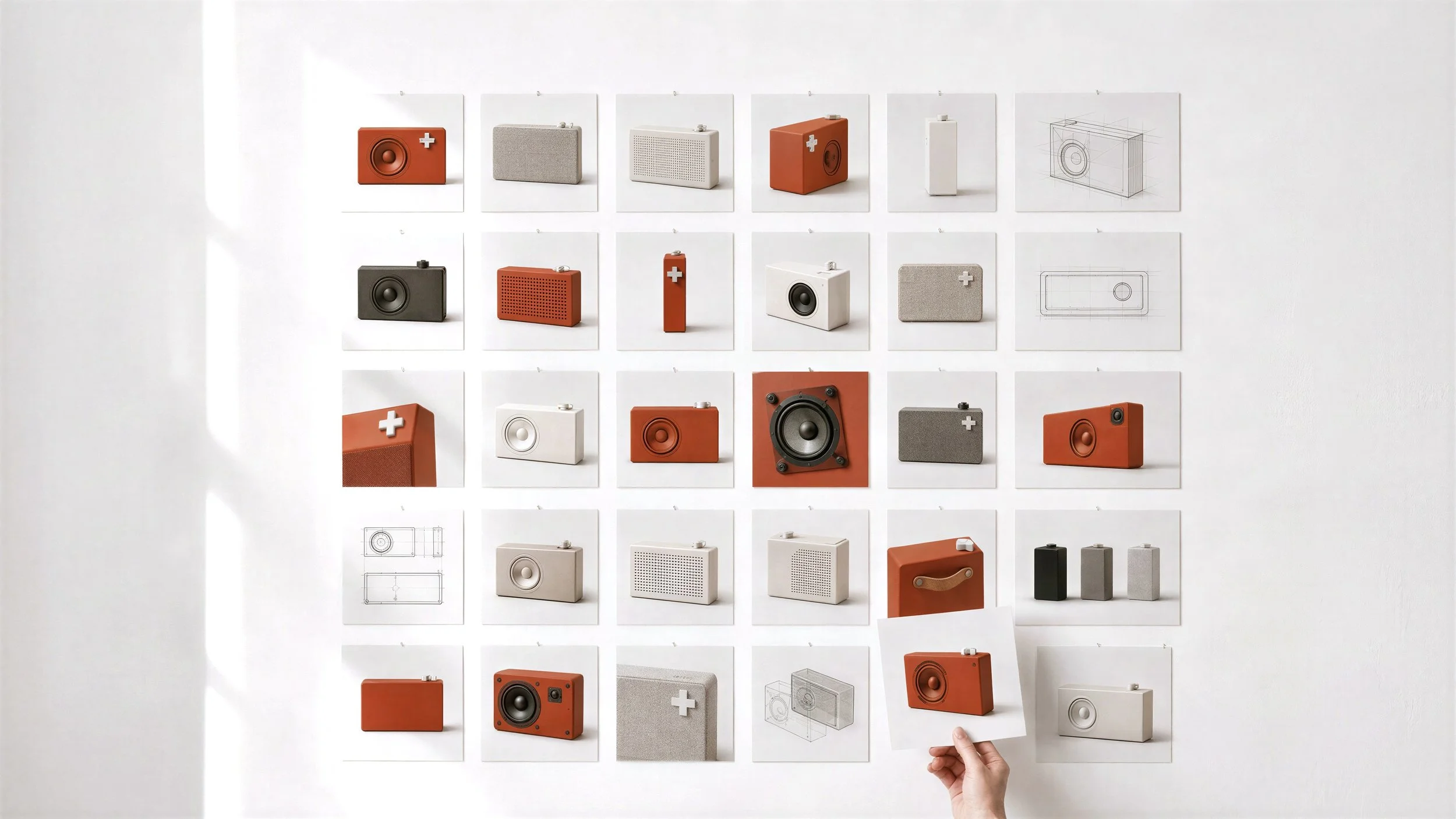
THE RADIO PROJECT

A simple object used to investigate how form organises relationships between function, perception and meaning.

THE RADIO PROJECT

A simple object used to investigate how form organises relationships between function, perception and meaning.

WHAT IS FORM AS THINKING?

FORM AS THINKING™ is an ongoing framework for understanding how form organises relationships between objects, materials, functions, perception and meaning.

Developed through three decades of design practice, teaching and research, the project explores form not as appearance, but as a way of thinking.

Form is the structure through which ideas become tangible. It determines how things are organised, how they communicate, and how they relate to people, technologies and culture.

In a time when AI can generate endless visual alternatives, understanding form becomes increasingly important. The challenge is no longer producing possibilities, but recognising meaningful relationships.

FORM AS THINKING™ seeks to provide a practical framework for reading, evaluating and constructing form in the age of AI.

Form is not appearance. Form is how design becomes real.

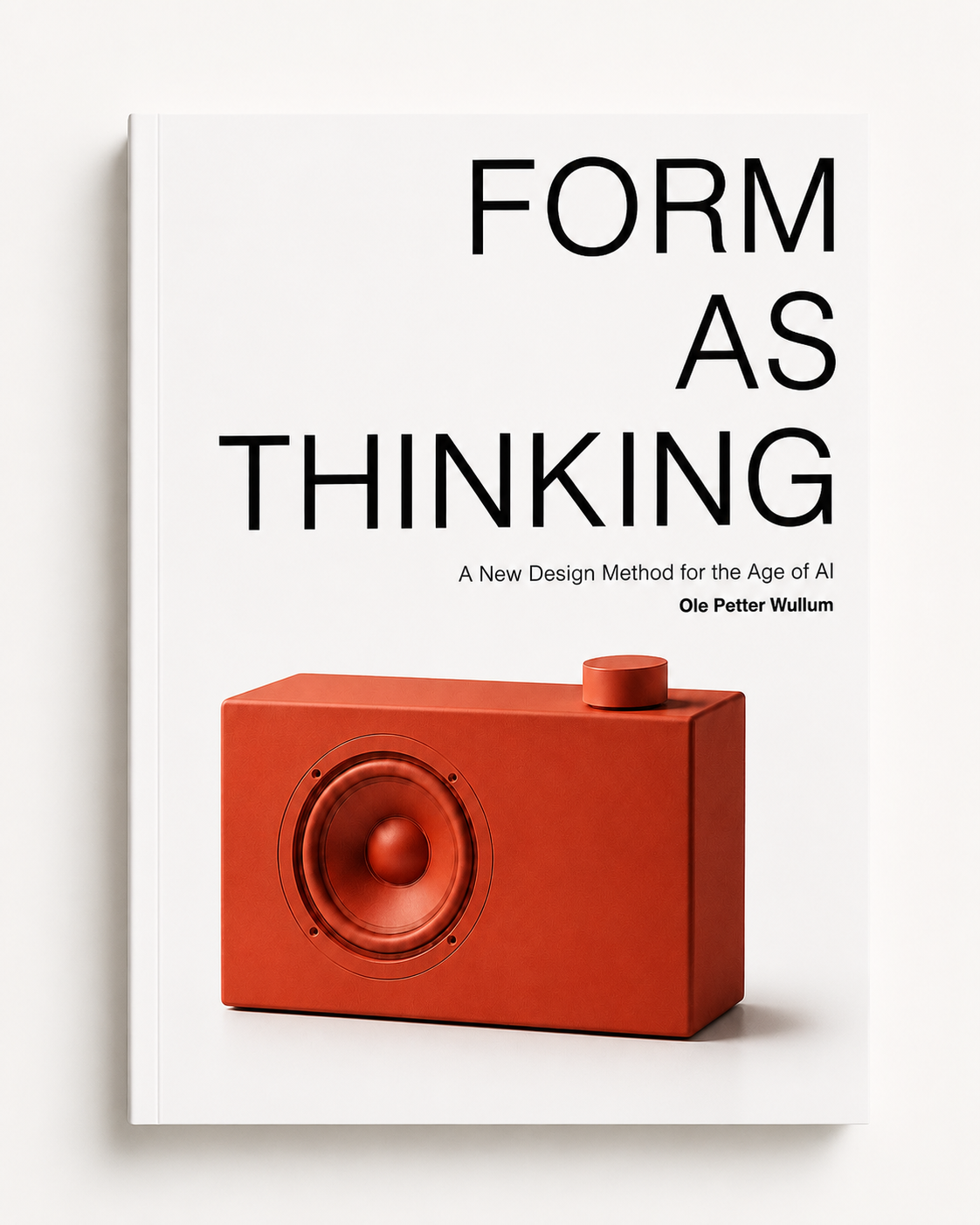
THE BOOK

FORM AS THINKING™ is currently being developed as a book exploring form as organisation, communication and relation.

Drawing on more than three decades of design practice, teaching and research, the book proposes a practical framework for understanding how form is constructed, perceived and evaluated.

Combining theory, visual analysis, design experiments and reflections on artificial intelligence, the project seeks to reconnect design practice with a deeper understanding of form.

The book is intended for designers, students, educators and anyone interested in how ideas become real through form.

Publication in development.
Reducing form to its essential relationships.

AI AS PERCEPTUAL PROTOTYPING

AI does not replace sketching. It extends sketching into perception.

Throughout design history, sketches, models and prototypes have been used to externalise ideas and make them available for reflection and judgement.

Artificial intelligence introduces a new stage in this process.

Rather than simply generating images, AI allows designers to prototype perception itself. Ideas can be visualised, tested, compared and evaluated long before they exist as physical objects.

This shifts the role of the designer. The challenge is no longer producing alternatives, but recognising meaningful relationships, making informed decisions and constructing coherent systems of form.

FORM AS THINKING™ describes this emerging condition as perceptual prototyping — a process in which AI becomes an extension of visual thinking, enabling designers to explore, evaluate and refine form through perception itself.

AI expands possibility.
Judgement creates value.
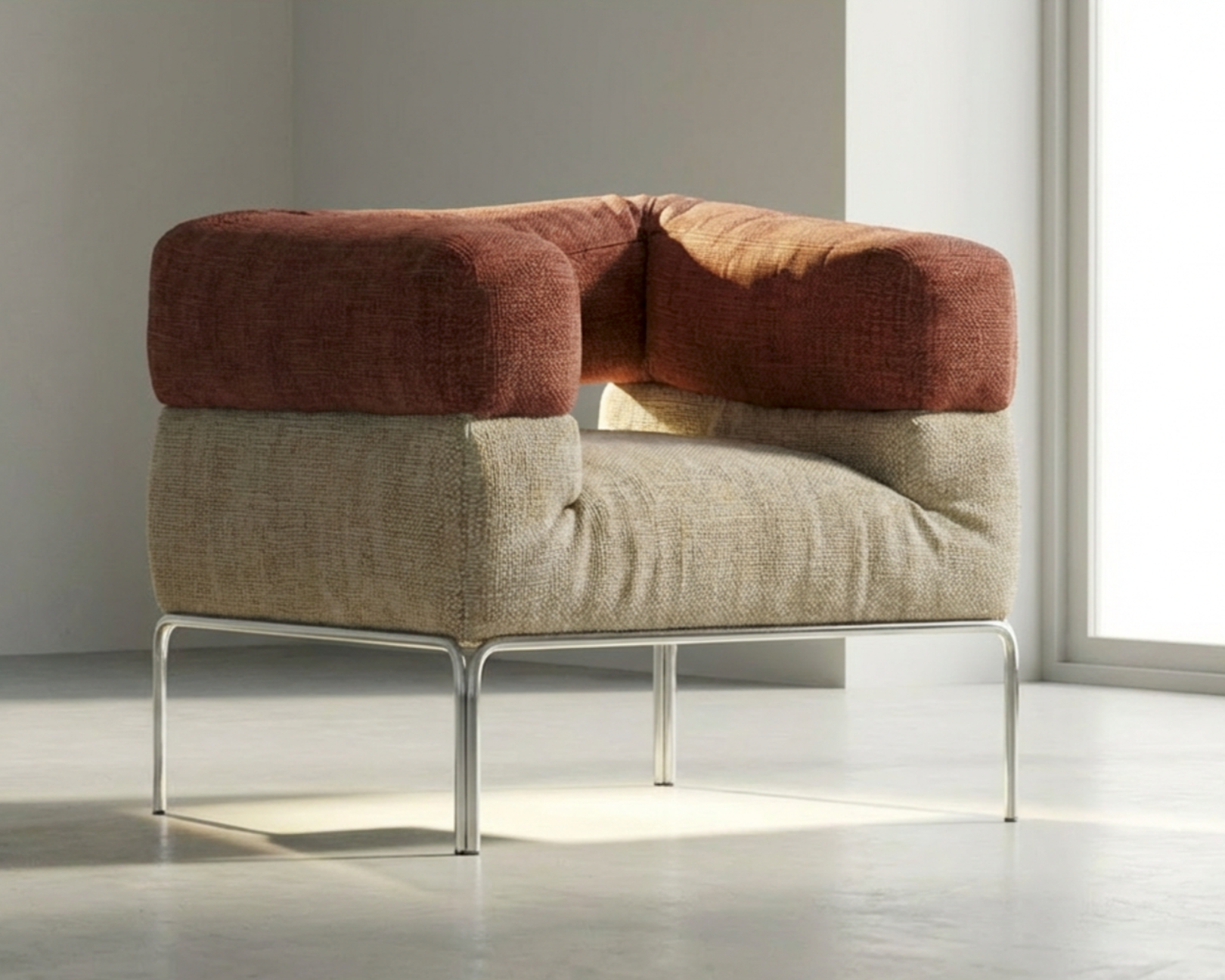
COLOURING WITH REALITY

Throughout my career I have relied on visualisation not simply as a means of representation, but as a means of evaluation. By making ideas appear real at an early stage, it becomes possible to assess proportion, character, atmosphere and meaning before they exist as physical objects. I describe this process as colouring with reality. The purpose is not to predict the final object, but to expose design decisions to judgement while there is still time to change them. AI does not introduce this way of working. It radically extends it. What previously required days of drawing and rendering can now be explored through hundreds of perceptual variations in a matter of hours.

FROM PERCEPTION TO REALITY

Design begins with imagination.

For centuries, sketches, drawings and models have helped designers externalise ideas and make them available for reflection and judgement. Today, AI extends this tradition by enabling the rapid construction of highly realistic visual worlds throughout the entire design process.

From the earliest intuition to the final product launch, ideas can be explored, tested and communicated within increasingly convincing representations of reality.

This process is not about prediction. It is about evaluation.

By giving form a temporary reality, designers can assess proportion, atmosphere, materiality, character and meaning long before physical prototypes exist.

I describe this process as colouring with reality.

The purpose is not to simulate the future, but to expose ideas to judgement while they can still be changed.

In this sense, AI does not replace imagination. It amplifies it.

By reducing the cost of visualisation, it allows designers to spend more time exercising their most important capability: the ability to imagine, compare, evaluate and construct meaningful futures.

IMAGINATION IS THE FIRST PROTOTYPE.
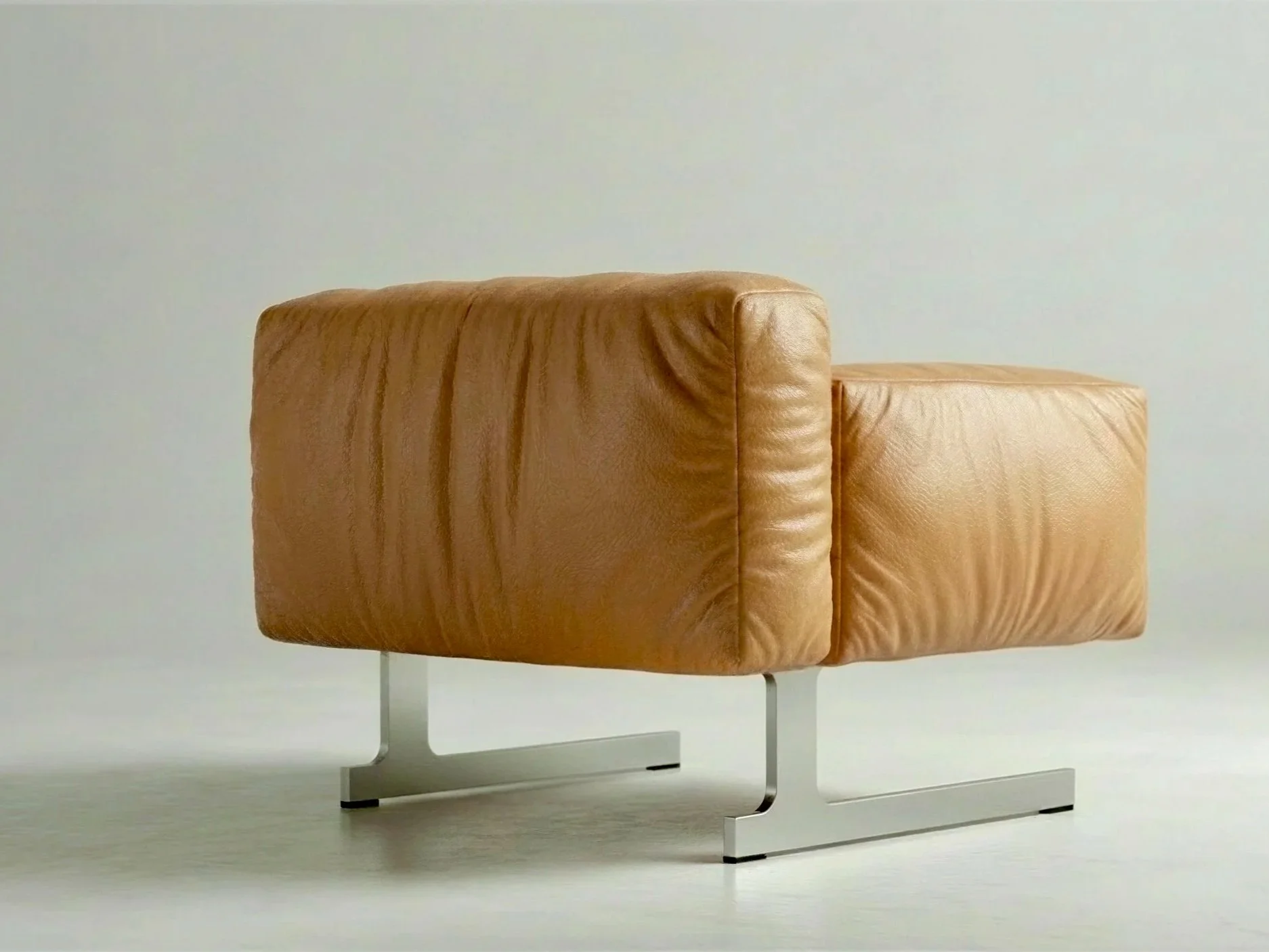
SELECTED ESSAYS

Short essays exploring form, perception, design and artificial intelligence through the lens of FORM AS THINKING™.

WHY REDUCTION MATTERS

In Search of Essence

(essay)

Reduction is often misunderstood.

It is frequently associated with minimalism, simplicity or the removal of visual elements. In this interpretation, reduction becomes an aesthetic preference — a style characterised by restraint and absence.

But reduction is not primarily about having less. It is about seeing more clearly.

At its best, reduction is a process of identifying what is essential and distinguishing it from what is merely possible. It is a search for the relationships that give an object coherence, meaning and presence.

Every design project begins with abundance. There are countless forms, materials, details, functions and directions available. The challenge is rarely a lack of possibilities. More often, the challenge is deciding which possibilities matter.

Reduction is therefore not subtraction for its own sake. It is a process of judgement. By removing the unnecessary, relationships become visible. Proportion becomes easier to evaluate. Structure becomes easier to understand. Meaning becomes easier to communicate.

In this sense, reduction is not the opposite of complexity. It is a way of organising complexity.

Many of the most enduring objects in design history appear simple. Yet their simplicity is rarely the result of simplification. It is the result of careful decisions made over time. Every element that remains has survived a process of evaluation. Every line, surface and connection contributes to the whole.

Reduction is therefore not a lack of information. It is concentrated information.

The designer’s task is not to remove until nothing remains. The task is to remove until what remains becomes meaningful. This search for essence has always been central to design practice. Whether through sketching, modelling, prototyping or visualisation, designers continuously test what can be eliminated, combined, strengthened or clarified.

Today, AI; artificial intelligence introduces a new dimension to this process.

For the first time, designers can generate and evaluate large numbers of perceptual alternatives at extraordinary speed. This does not reduce the importance of reduction. It increases it.

When possibilities become abundant, judgement becomes more valuable.

The role of the designer shifts from producing alternatives to recognising meaningful relationships within them.

Reduction becomes a way of navigating abundance.

Seen in this light, reduction is not a stylistic preference. It is a cognitive process. A way of thinking. A method for discovering what matters.

The goal is not simplicity. The goal is clarity.

Not less form, but better form.

Not fewer decisions, but more meaningful decisions.

Reduction matters because it allows form to reveal its essential relationships.

And it is through these relationships that objects acquire coherence, character and meaning.

THE RELATIONSHIP BETWEEN

FORM AND MEANING

Why Objects Communicate

(essay)

Objects are never merely functional.

They exist within systems of interpretation.

Long before an object is touched, used or understood, it has already begun to communicate. Through its form, material presence and organisation, it establishes expectations about what it is, how it should be approached and what kind of relationship it proposes to the world.

In this sense, objects are not passive things waiting to be used. They are active participants in the production of meaning. We do not encounter objects as neutral artefacts. We encounter them as cultural propositions.

Every object suggests something about order, value, behaviour and intention. It communicates ideas about permanence or change, precision or informality, authority or openness. These meanings are not attached to the object afterwards. They emerge through form itself.

Form is therefore not simply a vehicle for meaning. Form is one of the conditions through which meaning becomes possible.

This distinction is important.

Design discourse often separates function, aesthetics and meaning as if they were independent layers added one after another. Yet in practice they are inseparable. Function is interpreted through form. Meaning is experienced through form. Even the perception of usefulness is shaped by form.

We never encounter function directly. We encounter it through representation.

A chair may offer physical support, but before it is sat upon it has already communicated ideas about comfort, status, domesticity, efficiency or ritual. Its practical performance belongs to one register of experience. Its meaning belongs to another. Design operates simultaneously within both.

The significance of form therefore extends beyond utility.

Form organises perception. And perception organises understanding.

To design is not merely to solve problems. It is to construct the conditions through which objects become intelligible within culture.

Meaning does not reside in symbols alone. Meaning emerges through relationships.

Between part and whole. Between material and expectation. Between object and user. Between memory and experience.

The designer's task is therefore not simply to create objects, but to organise relationships capable of producing coherent meaning.

This is why form matters.

Not because it determines how things look. But because it influences how things are understood.

READING OBJECTS

Understanding Form Beyond Style

(essay)

Most people can recognise a chair. Far fewer can read one.

To recognise an object is to identify its category. To read an object is to understand the relationships that give it structure, character and meaning.

The distinction is important.

Design culture often treats objects as finished artefacts whose qualities can be judged through preference. We like them or dislike them. We find them beautiful or unattractive. Yet such responses rarely explain why an object appears coherent, convincing or meaningful.

To understand form requires a different kind of attention. It requires learning to read.

Reading objects is not unlike reading texts. A text is not merely a collection of words. Meaning emerges through relationships between words, sentences and structure. Likewise, an object is not merely a collection of parts. Meaning emerges through relationships between proportions, materials, functions, details and context.

Form is therefore relational.

Its significance rarely resides in isolated elements. A curve is not meaningful in itself. Neither is a material, a colour or a detail. Meaning emerges through the way these elements interact and support one another within a larger organisation.

This is why style can be deceptive.

Style often draws attention to visible characteristics. It encourages us to focus on surfaces, signatures and recognisable visual features. Form operates at a deeper level.

Style asks what an object looks like. Form asks how an object is organised.The difference is substantial.

Two objects may share the same stylistic language while being organised according to entirely different principles. Conversely, objects that appear visually different may be structured by remarkably similar relationships. To read form is therefore to look beyond appearance. It is to ask:

Why are these proportions organised in this way?

What relationships are being established?

What values are being prioritised?

How does the object construct meaning through its organisation?

These questions move attention away from taste and towards understanding.This shift becomes increasingly important in a world saturated with images.

Digital technologies and artificial intelligence have dramatically expanded our ability to generate visual alternatives. Yet the capacity to produce images does not necessarily improve our ability to interpret them.

On the contrary, abundance increases the value of discernment.

The challenge is no longer seeing more objects. The challenge is seeing more clearly. Reading objects provides a framework for this clarity.

It enables designers to move beyond intuition without abandoning it. It transforms judgement from personal preference into a more conscious evaluation of relationships, structures and consequences. Within FORM AS THINKING™, reading objects is understood as a foundational design skill. Not because it teaches designers what to make. But because it teaches them what they are looking at.

Before form can be constructed, it must be understood.

Before objects can be designed, they must be read.

Design begins not with making. It begins with seeing.

AI AS PERCEPTUAL PROTOTYPING

Visualisation as Evaluation

(essay)

The significance of artificial intelligence in design is often misunderstood.

Much of the discussion revolves around generation. Faster image creation. More alternatives. Greater efficiency. Yet generation is not the most important transformation taking place.

The real shift lies elsewhere.

For the first time in history, designers can construct highly realistic perceptual worlds at a speed and scale previously unimaginable. Ideas can be explored, compared, evaluated and refined long before they exist as physical objects.

This changes the role of visualisation.

Traditionally, sketches, renderings and prototypes have been used to represent design proposals. They made ideas visible. They helped communicate intentions to clients, manufacturers and users. But visualisation has always served another purpose. It has been a tool for judgement. Designers do not visualise ideas merely to present them. They visualise ideas in order to evaluate them. A drawing is not simply a representation of a future object. It is a way of thinking about that object. A rendering is not merely a presentation. It is an argument. A prototype is not simply a test. It is a question.

Artificial intelligence dramatically expands this evaluative dimension of design practice.

Rather than producing a single image, designers can now explore hundreds of perceptual alternatives. Variations in proportion, materiality, atmosphere, character and context can be generated and assessed within minutes. This process can be understood as perceptual prototyping.

The prototype is no longer only physical. It is perceptual.

Ideas are exposed to judgement through increasingly convincing representations of reality. Designers can evaluate how objects may appear, communicate and relate long before they are manufactured. This does not eliminate uncertainty. Nor does it predict the future. What it does is expand the space within which judgement can operate.

The value of AI therefore lies less in generation than in evaluation.

When alternatives become abundant, discernment becomes more important. The challenge is no longer producing possibilities. The challenge is recognising meaningful relationships among them.

This changes the role of the designer.

Designers become less occupied with drawing every alternative and more occupied with selecting, interpreting and directing them. Their role shifts from image maker to curator, editor and cultural strategist.

Technology expands possibility. Judgement establishes direction.

The essential task remains unchanged: to recognise coherence, meaning and value within a field of possibilities.

Seen in this light, AI does not replace imagination. It amplifies it.

By reducing the cost of visualisation, it allows designers to spend more time exercising their most valuable capability: the ability to imagine futures, construct relationships and evaluate consequences.

Design has always depended upon the cultivation of possibility. Artificial intelligence extends this tradition. Not by replacing human intelligence. But by providing a new medium through which intelligence can operate.

The future of design will not be defined by those who generate the most images. It will be defined by those who develop the strongest judgement.

AI expands possibility. Design gives it direction.

THE DIFFERENCE BETWEEN

STYLING AND FORM

Appearance, Structure and Meaning

(essay)

Form and styling are often treated as interchangeable concepts.

They are not.

The confusion is understandable. Both influence how objects appear. Both contribute to visual experience. Both shape first impressions. Yet they operate at fundamentally different levels.

Styling primarily concerns appearance. Form concerns organisation.

This distinction may seem subtle, but it has profound consequences for how objects are understood, developed and evaluated.

Styling works on the surface of an object. It modifies expression through colour, material, detail, finish and visual language. It influences how an object is perceived without necessarily altering the relationships that structure it.

Form operates at a deeper level.

Form organises relationships between parts, functions, materials, users and meanings. It determines how an object is constructed, how it behaves, how it communicates and how it relates to the world around it.

Styling can change the character of an object. Form changes the object itself.

This difference becomes clear when appearance is removed. A well-formed object often retains its coherence when colours, textures and decorative elements disappear. Its essential relationships remain intact. Its structure continues to communicate. A poorly formed object may rely heavily on styling to create interest, identity or distinction. Remove the surface treatment and little remains.

Form therefore precedes styling. Not chronologically, but conceptually.

Styling depends upon an underlying organisation. Form provides the framework within which expression becomes meaningful. This is why some objects remain relevant across decades while others quickly appear dated. Stylistic languages change. Relationships endure.

The history of design is filled with objects whose visual expressions have evolved while their fundamental organisational principles remain remarkably stable. Their longevity derives not from fashion, but from coherence.

Form is often mistaken for geometry. It is not.

Nor is it synonymous with shape. Form describes the organisation of relationships within a system. Geometry is one of the means through which these relationships become visible. An object may possess an interesting shape while lacking meaningful form. Conversely, an object may appear visually restrained while embodying a highly sophisticated formal organisation.

Understanding this distinction shifts the designer's attention.

The question is no longer: How should this object look?

The question becomes: How should this object be organised?

How should its parts relate?

How should its materials participate?

How should its function be communicated?

How should meaning emerge?

These are questions of form.

Styling remains important.

Objects exist within culture, and culture is inseparable from expression. Materials, colours and visual languages influence interpretation and identity. Yet styling is most effective when it amplifies an underlying formal logic rather than compensating for its absence.

Good styling can strengthen good form. It cannot replace it.

Within FORM AS THINKING™, form is understood as the primary organisational structure through which meaning, function and expression become coherent.

Styling may shape appearance. Form shapes understanding.

One decorates relationships. The other constructs them.

This is the difference.

And it is the difference upon which design ultimately depends.